
For a long time I thought the loud voice in my head was discipline. The one that surveyed the day at five in the morning and immediately wanted to know which of the open threads had moved overnight. The one that registered any quiet hour as something owed back. The one that, when nothing was wrong, scanned harder for what might be wrong soon.
It was not discipline. It was a sub-routine.
What the manager-self is
The manager-self is a protective controlling sub-routine the nervous system installed early. The conditions varied by household: an over-present adult, an under-present adult, a household that ran on the felt urgency of one person and the felt absence of another, a setting where ease was unsafe and someone needed to monitor what the adults were not monitoring. The specifics differ. The installation is similar.
A small body cannot tolerate a household that runs without a controller, so it builds one inside. That builder becomes the manager-self. It monitors, overrides, enforces. It runs the show from underneath. It is not the whole self. It is one function of the ego, the controlling sub-routine, kept on indefinitely because nobody filed the paperwork to retire it.
This is the distinction worth holding. The ego is the larger system: identity, preferences, history, the continuous sense of being a person. The manager-self is one function inside the ego, the protective controlling one. Killing the manager-self is not what the work is. The work is recognizing that one function has been running like it is the whole system, and letting the rest of the ego come back online.
The verb is the fingerprint
The manager-self is hard to see because it is the thing doing the looking. Most diagnostics for it require effort, which produces another manager-self running the diagnostic. There is a cheaper route.
The verb the operator is living from at any moment is a fingerprint. Manager-verbs place a controller inside the sentence: ought, allow, achieve, regulate, fill, manage, fix. State-verbs do not: be, become, open, return, am, sit, rest. The presence of a manager-verb is a quiet signal that the controlling sub-routine has the wheel right now. The presence of a state-verb is a quieter signal that something else does.
This is not a categorization exercise. It is a single-step witness check. I ought to be doing something with this hour. That sentence carries a manager-verb and an implied ledger. I am sitting with this hour. That sentence does not. The two describe the same hour. They are different operators running it.
Noticing the verb is the practice. No fixing is required. The noticing is the witness operating, and the witness is the part of the ego that can see the manager-self for what it is.
Why it gets louder when nothing is wrong
The counterintuitive feature of the manager-self is the one operators notice last and need the most. The manager-self runs hardest when nothing is wrong.
The mechanism is direct. The manager-self exists to monitor, override, and enforce. When nothing needs monitoring, its function becomes invisible. An invisible function reads inside the system as one about to be retired. So the manager-self generates urgency from inside: a small voice saying do something, anything. The operator hears it as instinct or discipline or responsibility. It is the sub-routine staying relevant, not a description of what the present moment requires.
This is the same engine described in why calm feels dangerous when you’re scaling. The earlier post named the nervous-system pattern at the felt level. This one names the agent underneath. The manager-self is what scrambles to manufacture a problem when no problem is presenting itself, because its function depends on a problem.
The flag in the body is the urgency that arrives unattached to a specific situation. A held breath in the absence of a deadline. A scan that runs without finding anything to scan for. A reaching forward that has no destination. None of that signals an actual issue. It signals the sub-routine doing its job, the wrong job, on a body that no longer needs it.
What “retire, do not kill” actually means
The reflex when an operator first sees the manager-self is to want it gone. That reflex is itself a manager-self move dressed as freedom. The same controlling function that ran for years or even decades now tries to control its own retirement by force. The pattern persists because the verb persists.
Retiring the manager-self is not silencing it. It is recognizing it as a sub-routine that had a specific original job, has been kept on long past that job’s relevance, and can now be moved into a smaller, more specific role. Discriminator of actual danger. Complex coordination when warranted. Not the background process running every waking hour.
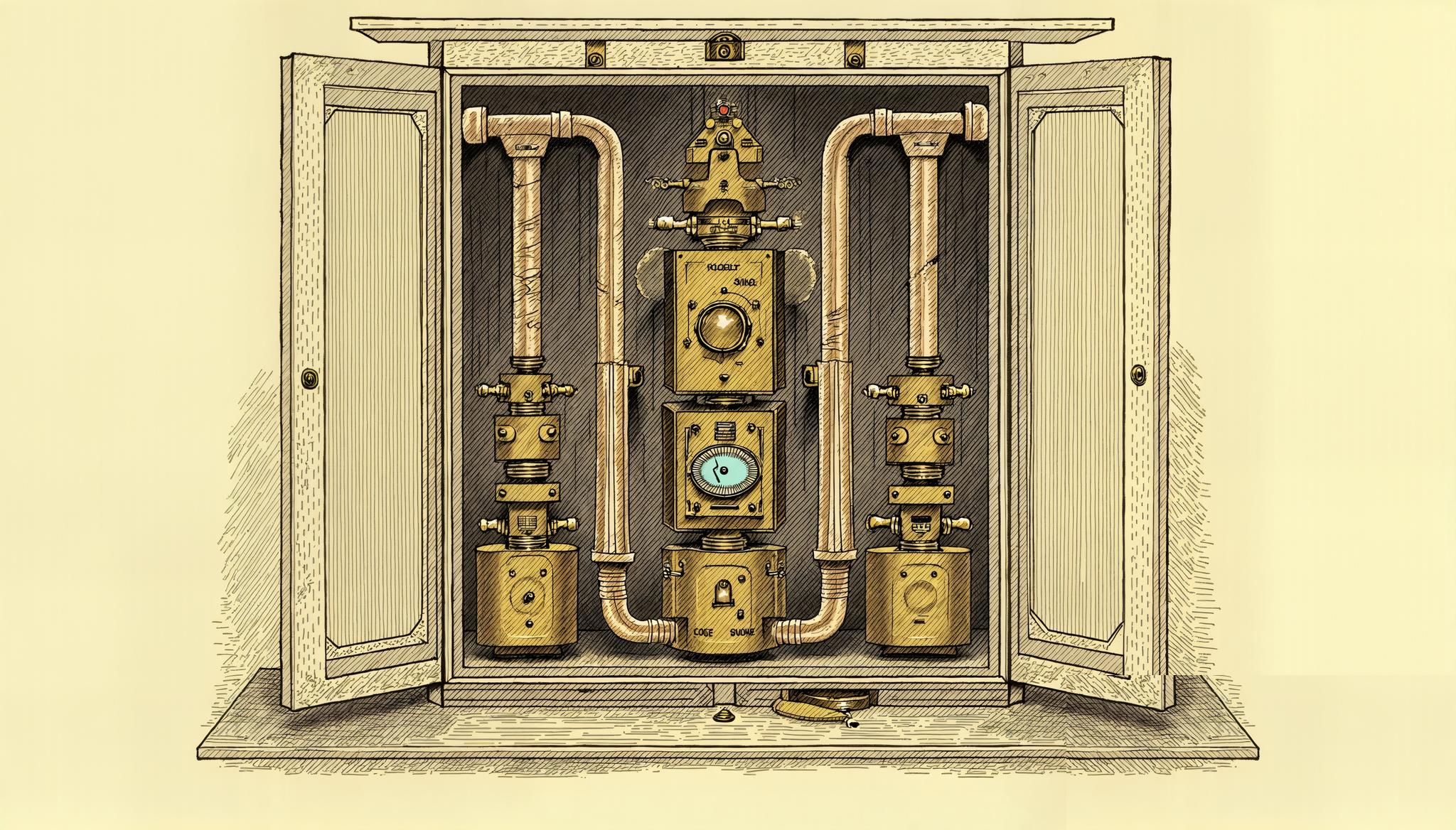
The image worth holding is the engineered controller sitting on a corner workbench, intact, still oiled, currently regulating nothing because nothing in front of it needs regulating. The workshop continues to run. The controller is respected. It can be brought back online when the load calls for it. It is not the operating system of the workshop anymore.
The practice that gets the manager-self into that corner is not heroic. It is mostly verb-checking and waiting. Noticing the verb. Not acting on the urgency until the urgency clears. Returning to a state-verb when one is available. Letting the next move, when it arrives, come from the part of the ego that does not need a controller in the middle of the sentence to feel safe.
What lands on the other side
A business run by the manager-self looks competent from the outside and feels like grinding from the inside. The proposals get sent. The deliverables ship. The calendar fills. Underneath, the operator is paying a hidden tax: every move funded by urgency rather than by clarity, every quiet hour interpreted as a deficit, every win interpreted as a brief truce before the next thing the sub-routine has to monitor.
A business run with the manager-self retired into a smaller role looks similar from the outside. The proposals still get sent. The deliverables still ship. The calendar still fills, more selectively. The difference is in the fuel. The operator is no longer paying the tax. The decisions come from a wider part of the ego than the controlling function. The quiet hours read as quiet hours. The wins land in the body that did the work, not the body that was scanning for the next thing to control.
The same script that ran the career can be heard rather than obeyed. Do something, anything shows up. The operator notices the verb. Names the source. Returns to the state the present moment is already in. The script continues to fire for a while, with less and less compelling force as it becomes audible.
The manager-self is not the enemy. It got the operator here. The work is letting it sit on the corner workbench, intact and respected, while the rest of the system comes online to run the load.